Author, playwright, artist, designer, wish I could do at least one of those well enough to be somewhat memorable.
Prunella Vulgaris's compendium, or: A companion for the ingenious of either sex. The newest experiments in japanning, to imitate the Indian way, plain and in speckles, rockwork, figures, &c. The art of persuming and beautifying. Divers receipts in physick and surgery, with many other useful things. To make enamel of divers colours for gold, silver, or other metals. To which are added, many curiosities, and rare secrets, known to few, but very profitable and pleasant.
Showing posts with label paintings. Show all posts
Thursday, November 15, 2012
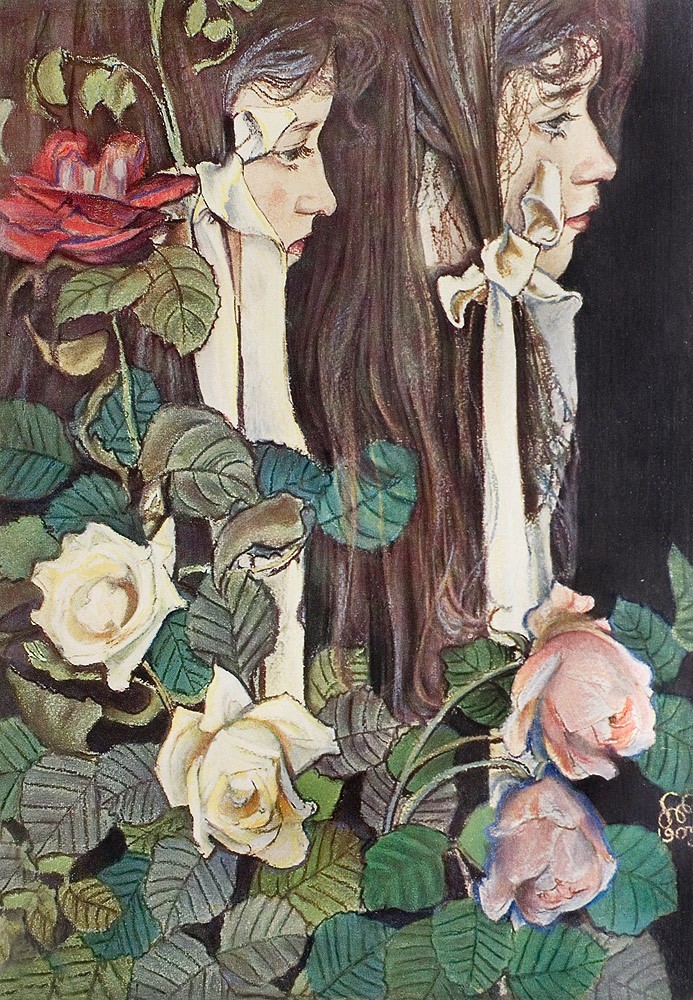
stanislaw wyspanski
Author, playwright, artist, designer, wish I could do at least one of those well enough to be somewhat memorable.
Thursday, August 9, 2012
jan toorop
JAN TOOROP (British/Dutch/Javanese, 1858-1928)
Jan Toorop
was born in Purworedjo, Java to a British mother and
Dutch/Javanese father. At the age of five he moved to Banka, a small
island southeast of Sumatra, and then to the Leiden in 1869. He studied
as a teenager at the State Academy in Amsterdam, and then between 1882
and 1886 he lived in Brussels.
There, he became connected with an avant-garde group of artists connected to James Ensor. After experimenting with a number of modernist styles, he eventually developed a unique, personal symbolist style which often included Javanese elements...In 1905 Toorop converted to Catholicism, and took an interest in the mysteries of Rosicrucianism, an esoteric order.
In the
later part of his career he created works inspired by the Pointillist
style of Georges Seurat and also Art Nouveau. From 1920 onward Toorop
was confined to a wheelchair, due to the paralysis of his left leg,
devoting himself to drawings and graphics with Catholic themes. He died
on March 3, 1928 in The Hague, Netherlands.
Love this guy's art, the fascist politics (he was a fan of Mussolini) not so much. But Kahlo was a fan of Stalin, and it'd be unfair to write off this work based on that.
where o Death is your victory?
fatalism
the three brides
the vagabonds
Le retour sur soi-même
the prayer
Friday, July 6, 2012
here be monsters
A link here, a click there, and suddenly I'm tumbling down another geeky rabbit hole of sweetness. As mentioned before, I've loved Japanese art for pretty much ever, and I'm a sucker for monsters and general straunge and vvonderfulness especially in pre-cinematic times. I've never gotten into anime really, but I can see a lot of the parallels from what I have seen and what I know from those who dwell in that world. Anyways, these are nishiki-e newspaper prints detailing what Pravda English might call "anamalous phenomena" involving all manner of freaky-deaky ghosts and monsters wreaking havoc on regular folk.
In the early morning hours of August 4, 1873, a man named Umemura
Toyotaro was awakened by an earthquake. As he struggled to get back to
sleep, his child, who lay nearby, suddenly burst out crying
hysterically. The man looked up to find a strange, three-eyed monk
standing over them. He watched in disbelief as the mysterious monk grew
taller and taller, until his head reached the ceiling. Unrattled, the
man grabbed the monk's sleeve and pulled him to the ground. The monk
turned out to be an old shape-shifting tanuki.
Around twelve midnight a monster would appear in the house of a master carpenter in the Kanda area of Tokyo and do "horrible things" to his sleeping wife. Unable to endure it, the family had prayers chanted to ward off the monster, the article reports. This monster, which does look lecherous, may have been the sort of evil spirit that appears in one’s dreams.
Despite appearances, this monster means no harm. The helpful creature
is attempting to reform a failed Hyogo-area politician named Nakayama,
who neglected his responsibilities after falling victim to a widow's
charms.
This print depicts a giant alligator inhabiting the Koga inlet of
eastern Mie prefecture. The feared sea monster, which was described as
being covered in seaweed and oysters, was known to attack ships and
devour anyone thrown overboard. One day a ship in the area caught fire.
As the crew abandoned the burning vessel, the creature ate them all.
I'm also not sure how I never learned about Utagawa Kuniyoshi until now, but expect more of him in posts to come.
Kuniyoshi depicting a samurai stabbing a giant salamander.
In Japanese folklore, Gashadokuro, (がしゃどくろ) also known as Odokuro, are giant skeletons, fifteen times taller than an average person. If a Gashadokuro sees a human, it will grab it and attempt to bite its head off. Gashadokuro are created from gathering bones from people who have died of starvation. The only way a Gashadokuro can be detected before it appears is by hearing a ringing in one's ears.
Around twelve midnight a monster would appear in the house of a master carpenter in the Kanda area of Tokyo and do "horrible things" to his sleeping wife. Unable to endure it, the family had prayers chanted to ward off the monster, the article reports. This monster, which does look lecherous, may have been the sort of evil spirit that appears in one’s dreams.
I'm also not sure how I never learned about Utagawa Kuniyoshi until now, but expect more of him in posts to come.
Kuniyoshi depicting a samurai stabbing a giant salamander.
In Japanese folklore, Gashadokuro, (がしゃどくろ) also known as Odokuro, are giant skeletons, fifteen times taller than an average person. If a Gashadokuro sees a human, it will grab it and attempt to bite its head off. Gashadokuro are created from gathering bones from people who have died of starvation. The only way a Gashadokuro can be detected before it appears is by hearing a ringing in one's ears.
Monday, June 4, 2012
koloman moser
beautiful stuff right here, deemed decadent by fascists, but when did they ever know anything about enduring art?
Subscribe to:
Posts (Atom)